

Smart Water Dispenser Features in 2026: TDS Monitoring, Filter Alerts and Auto Sleep
Market Context
The global water purifier dispenser market exceeded US$42 billion in 2025, growing 8.3% year-on-year. Within that total, models equipped with smart control functions accounted for more than 34% of shipments — a threshold crossed for the first time. By mid-2026, IoT module integration in dispensers reached 41%, with remote water quality monitoring, filter life alerts, and automated disinfection becoming standard on mid-to-high-end units.
This shift is not merely cosmetic. It reflects a structural change in what buyers expect from a dispenser: not just hot and cold water, but verifiable water quality, predictable maintenance, and measurable energy savings. For manufacturers, the three features that have moved from “optional” to “expected” in B2B procurement specifications are TDS monitoring, filter replacement alerts, and auto sleep modes. This article examines each in turn, with attention to the engineering details that determine whether they function as genuine utilities or as marketing checkboxes.
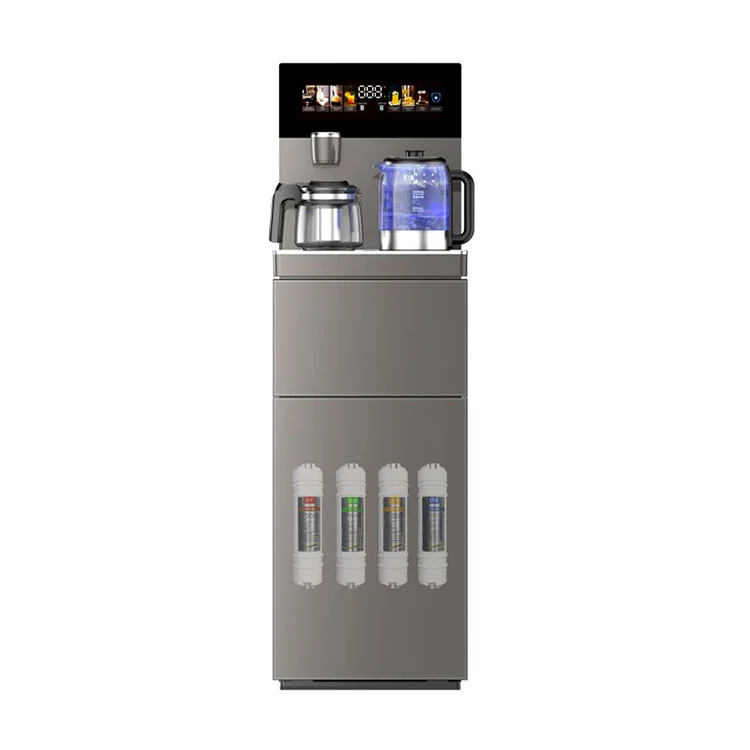
TDS Monitoring: From Indicator Light to Measurement Instrument
TDS (Total Dissolved Solids) monitoring is now the most widely adopted water quality feature on smart dispensers. The underlying technology is straightforward: a conductivity sensor measures the electrical conductance of water, and the system converts that reading into a TDS value in parts per million (ppm). A post-RO TDS reading of 50 ppm or below is generally accepted as an indicator of effective membrane performance.
What separates capable implementations from basic ones is sensor accuracy and temperature compensation. Water conductivity increases by approximately 2.1% for every 1°C rise in temperature. Without compensation, a dispenser reading in winter will under-report TDS, and one reading in summer will over-report. Reputable TDS probes therefore include an NTC thermistor that adjusts the reading in real time.
The accuracy benchmark is also tightening. The industry common requirement has been ±3 ppm, but leading models now achieve ±1.5 ppm, using dual-channel sensing: one sensor measures raw inlet water TDS, while a second compares the post-filter value. The difference between the two readings, combined with an RO membrane flux decay model, allows the system to calculate actual filter performance rather than relying on a simple timer.
For commercial buyers, a TDS display has practical value beyond reassurance. It provides a daily, non-invasive check on whether the RO membrane is still performing. If the post-filter TDS begins to rise while inlet TDS remains stable, the membrane is approaching the end of its service life. This is a more reliable signal than a calendar-based reminder, because it responds to actual water quality and usage volume.
Filter Alerts: Moving Beyond Calendar-Based Reminders
Filter replacement alerts have evolved through three generations. The first was a simple elapsed-time counter. The second added cumulative water volume tracking, usually measured by a flow sensor. The current generation combines TDS differential readings, flow data, and membrane performance models to estimate remaining filter life dynamically.
A representative example: Philips’ countertop RO dispenser uses a filter lifetime indicator that estimates replacement timing based on usage, with a rated cartridge life of up to 12 months or 2,000 litres. The LED display shows filter status alongside water quality readings, so the user does not need to interpret a separate manual. iSpring’s RCD100 model takes a similar approach, with a smart panel that monitors filter lifespan and provides timely reminders when replacement is needed.
Some implementations go further with graded alerts. One commercially available RO dispenser uses an orange flashing light when filter life reaches 20%, and a solid red light when replacement is overdue. This two-stage approach is more useful in shared commercial settings than a single “change filter” icon, because it gives facility managers a predictable window to order replacements before performance degrades.
The weakness in many current systems is that they monitor usage but not actual water quality at the point of delivery. A dispenser in a low-TDS municipal supply area may indicate “filter life remaining: 30%” when the membrane is still performing optimally, while a unit in a high-TDS region may show the same 30% when performance has already declined. The next generation of filter alerts, already visible in patent filings, addresses this by integrating water quality scores with replacement prompts and location-based water data.
Auto Sleep: Energy Savings That Do Not Compromise Availability
Auto sleep functionality addresses a specific inefficiency in traditional dispensers: the heating element and compressor run continuously to maintain standby temperature, even when no one is drawing water. In an office with a fixed schedule, this means the machine is maintaining hot and cold water overnight and through weekends for no reason.
The standard implementation is an inactivity timer. After a set period without dispensing — commonly 30 minutes to 3 hours, depending on the model and setting — the dispenser enters a reduced-power state. In sleep mode, the heating and cooling circuits are disabled, and only the control board remains powered. Some units achieve standby power consumption as low as 1.2 watts.
A more advanced approach uses presence detection rather than a timer. A utility patent published in April 2026 describes a microwave radar sensor mounted on the dispenser front. When the radar detects no moving object within range for a set interval, the main control unit switches off the solenoid valve and heating element, placing the machine in a dormant state. When a person approaches, the radar wakes the system immediately. This eliminates the compromise inherent in timer-based sleep: the machine is always cold and hot when someone is present, and always off when the room is empty.
For commercial buyers, the practical implication is that auto sleep should not be evaluated solely on its wattage rating. The more relevant questions are: how quickly does the machine recover to dispensing temperature after waking, and can the sleep schedule be aligned with actual occupancy patterns? A dispenser that takes three minutes to deliver hot water after waking is functionally slower than one that maintains a low-power standby at 45°C.
What This Means for Dispenser Procurement
The three features discussed here are converging into a common expectation among commercial buyers. A 2026 market analysis notes that “smart purifiers can detect total dissolved solids (TDS) levels, monitor filter life,” and that manufacturers are embedding features for “remote monitoring, personalized settings, and automatic reordering of supplies”.
For procurement teams evaluating dispensers, the following distinctions are worth making:
TDS monitoring: Confirm whether the sensor includes temperature compensation and whether the displayed value reflects post-filter water. A raw-water TDS reading alone is less useful than a differential reading between inlet and outlet.
Filter alerts: Determine whether the reminder is based on elapsed time, cumulative volume, or actual water quality data. The last is the most responsive to real operating conditions.
Auto sleep: Check the wake-up time and whether the sleep schedule is adjustable. Presence-based activation (radar or infrared) is generally preferable to fixed timers in variable-occupancy settings.
A Note on Certification
Smart features do not replace fundamental water safety. NSF/ANSI 42 covers aesthetic claims such as chlorine and particulate reduction; NSF/ANSI 53 covers health-related contaminant claims including lead and Cryptosporidium. A dispenser may display an accurate TDS reading while using a filter cartridge that has not been certified for the contaminants present in the local water supply. TDS and filter alerts are management tools, not substitutes for appropriate filtration certification.
As the smart dispenser category matures, the distinguishing factor among products will not be the presence or absence of a display. It will be whether the data on that display reflects genuine sensor measurement and whether the machine’s behavior — heating, cooling, sleeping — responds to actual use patterns rather than predetermined timers. Buyers who understand the difference will make better procurement decisions; manufacturers who can demonstrate it will hold an advantage in an increasingly feature-saturated market.